


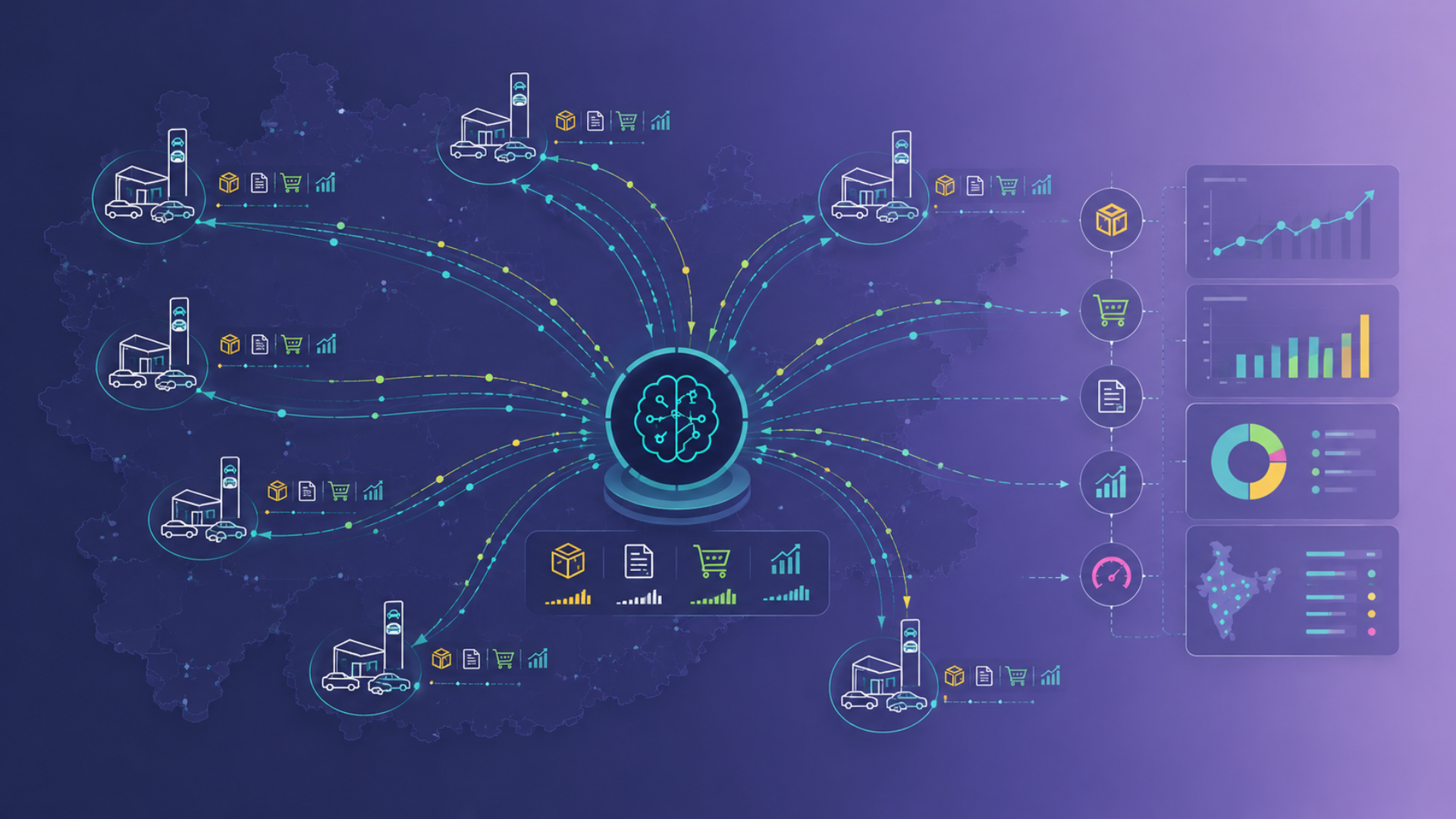
Dealer networks are, in theory, rich with data. Inventory levels, order histories, pricing records, service job cards, customer interactions, payment and credit data, scheme and incentive uptake — all of it generated continuously across thousands of touchpoints.
In practice, most of that data is fragmented, delayed, and inconsistent in ways that make it significantly less useful than it appears on a system architecture diagram. The dealer management system records transactions after the fact. The order portal captures requests but not the conversations that precede them. The field sales reporting system reflects what the sales team chose to log, which is rarely everything that happened.
AI deployed into this environment operates on what is actually available, not on what is theoretically present. And the gap between what is theoretically present and what is actually available in a clean, timely, consistent form is where most dealer network AI deployments either succeed or fail.
This piece covers what data AI actually needs to work in a dealer network, where that data typically lives, what common gaps exist, and what it takes to close them.
Why Dealer Network Data Is Harder Than It Looks
The dealer network data problem has three components that compound each other.
Fragmentation. A large dealer network generates data across dozens of systems: the manufacturer's ERP, the dealer management system at each location, the parts ordering portal, the field sales mobile application, the warranty claim system, the customer relationship platform, and often a collection of spreadsheets and manual processes that fill the gaps between them. None of these systems was designed to work together as a unified data layer. Each captures a part of what is happening in the network. None captures the whole.
Latency. Most dealer network data is batch-processed rather than real-time. Inventory positions are updated overnight. Sales reporting arrives weekly. Scheme activation data comes in monthly. This latency means that AI operating on dealer network data is almost always making decisions on information that is hours, days, or weeks old. For use cases like inventory rebalancing, competitive response, or intervention in a dealer that is underperforming, that latency makes the AI significantly less effective than it could be with real-time data.
Inconsistency. The same data element often means different things across different dealers or different systems. A "sale" in the DMS might be recorded at invoice date, delivery date, or registration date, depending on which dealer you are looking at and which system is recording it. A "stock unit" might include units in transit or might not, depending on how the inventory system has been configured at each location. These inconsistencies are invisible until AI starts producing outputs that do not match what field teams are seeing on the ground.
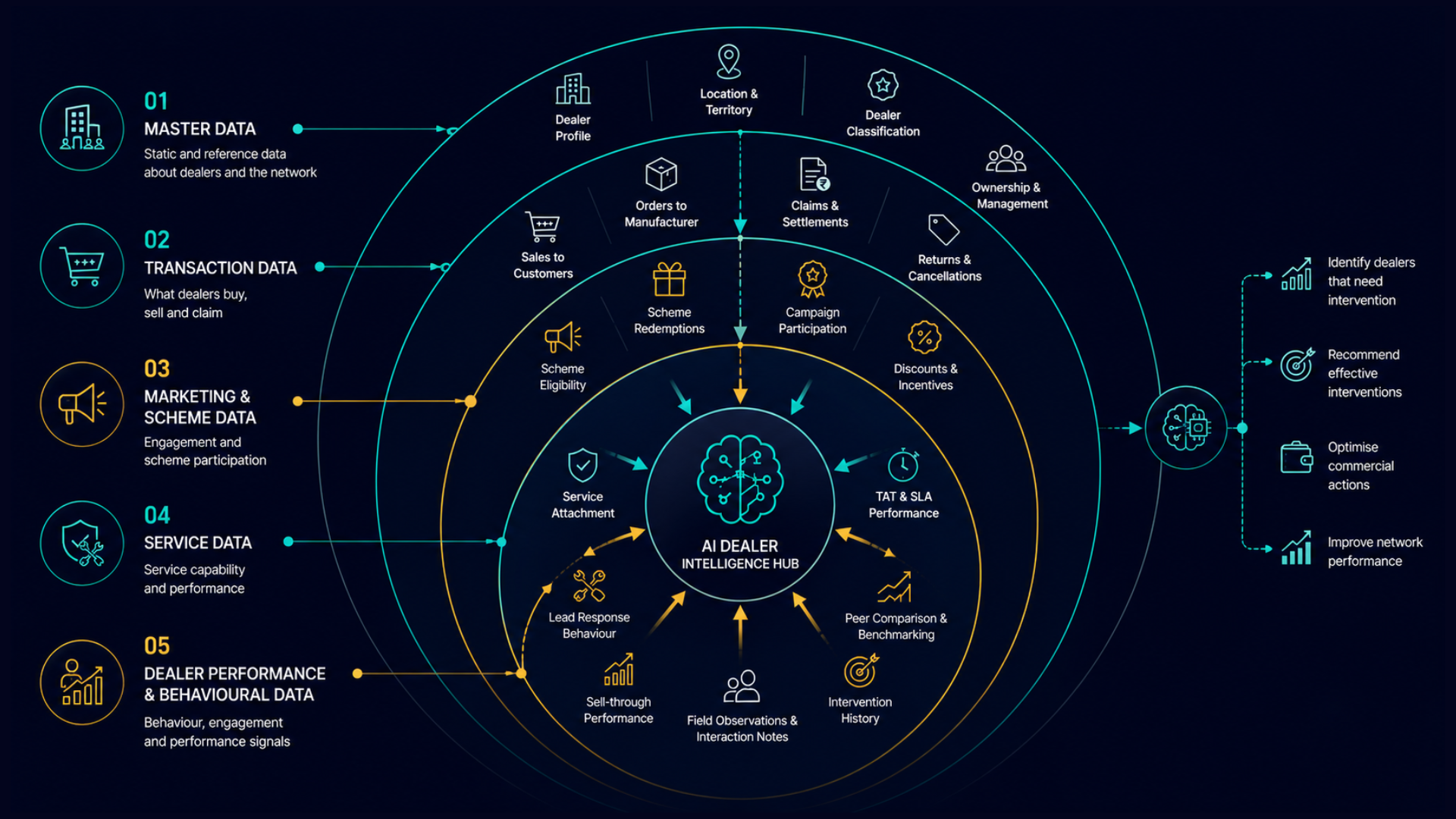
The Five Data Categories AI Needs
1. Inventory and availability data
This is the most foundational data category for dealer network AI and the one most frequently delivered in a form that is inadequate for real AI use.
AI that is helping a dealer identify what to order, or helping an OEM identify where inventory imbalances are developing, needs to know the current inventory position at every dealer location, what is in transit and when it will arrive, what is on order and from which source, and how current stock levels compare to recent demand patterns and forward-looking demand signals.
The common failure mode is that inventory data is available at the SKU level but not at the location level in real time, or is available in the DMS but not accessible to external systems without a manual export process that runs daily rather than continuously. AI operating on daily inventory snapshots in a market where stock positions can change significantly within a day produces recommendations that field teams cannot trust and eventually stop using.
2. Transaction and order history
Transaction history is the primary signal AI uses to understand demand patterns, identify seasonal trends, spot anomalies, and forecast forward-looking needs. For dealer network AI, the relevant transaction data includes sales by model, variant, colour, and configuration; parts orders and fulfilment; service job types and frequencies; and scheme and incentive redemptions.
The depth of history matters as much as the recency. AI models trained on less than 18 to 24 months of transaction history will miss seasonal patterns and multi-year demand cycles that are significant in automotive and consumer durables markets. The common gap here is that transaction data from dealer management systems is available but not in a consistent format across the network, requiring significant cleaning and normalisation before it can feed AI models reliably.
3. Dealer performance and behavioural data
For OEM and consumer electricals manufacturers managing a dealer network, the data that drives the most commercially valuable AI use cases is not just transaction data but dealer behavioural data: how quickly dealers respond to leads, how consistently they participate in scheme activations, how their ordering behaviour correlates with their actual sell-through performance, and how their service attachment rates compare to peers in similar market conditions.
This data is particularly valuable for AI that is trying to identify which dealers need intervention, what kind of intervention is likely to be effective, and what commercial actions the manufacturer should take to optimise network performance. It is also particularly difficult to collect consistently, because much of it comes from field sales observations and dealer interactions that are incompletely captured in formal systems.
4. Customer and interaction data
The customer data that matters for dealer network AI spans the full ownership lifecycle: initial enquiry and purchase, finance and insurance arrangements, service history, warranty claims, retention and repurchase behaviour. For consumer-facing AI applications including personalised offers, proactive service outreach, and retention campaigns, this data is the primary fuel.
The challenge in most markets is that customer data is distributed across systems that do not share a common customer identifier. A customer who purchased through one dealer, services at a different location, and submits a warranty claim through the manufacturer's portal exists as three separate records in three separate systems. AI that is supposed to create a unified view of the customer relationship cannot do so without the data engineering work that creates and maintains a consistent customer identity across these sources.
5. Market and competitive signals
The final data category is the one that is least commonly integrated into dealer network AI but increasingly significant: external signals about market conditions, competitor pricing and availability, consumer demand trends, and economic indicators that affect purchase timing.
AI that can combine a dealer's internal inventory and sales data with external signals about regional demand conditions, competitor stock positions, and macroeconomic indicators relevant to purchase timing will produce significantly better recommendations than AI working from internal data alone. This data typically comes from third-party market intelligence providers, publicly available vehicle registration data, and increasingly from digital advertising platforms that surface consumer intent signals in near real time.
The Integration Architecture That Makes It Work
Having the right data in theory is not the same as having it available to AI in practice. The integration architecture that connects data sources to AI systems in a dealer network determines whether the AI operates on rich, timely, consistent data or on a subset of what is available filtered through batch processes and manual interventions.
Three architectural principles consistently make the difference between dealer network AI that works in production and dealer network AI that works in demonstrations.
Real-time rather than batch:
The most commercially valuable dealer network AI use cases — stock rebalancing, intervention in an underperforming dealer, competitive response to a pricing move — require data that is current to hours, not days. Building the data pipeline to deliver real-time feeds from dealer systems rather than nightly batch extracts is foundational infrastructure work that is consistently underinvested in.
A unified data layer above the DMS:
Rather than trying to directly integrate AI with each dealer's DMS, which varies across the network and creates a maintenance overhead that scales with the number of dealer locations, the more sustainable architecture is a unified data layer that normalises and consolidates data from all sources into a consistent format. This layer is the foundation that makes it possible to add new AI use cases without rebuilding the data integration for each one. It is the same principle that makes enterprise AI work alongside legacy ERP in manufacturing environments.
Governance at the data layer:
Dealer network data includes commercially sensitive pricing information, customer personal data subject to privacy regulations, and financial data with audit requirements. The data layer needs to include access controls, data residency management, and audit logging that satisfy both regulatory requirements and the commercial sensitivities of the dealer relationship. AI systems that access dealer data without a governed interface create both regulatory exposure and commercial trust problems with the dealer network.
What to Fix Before Deploying AI
The most common and most expensive mistake in dealer network AI deployment is deploying AI before the data foundation is ready, and discovering the data gaps after the AI has been producing outputs that field teams and dealers cannot trust.
Three preparation steps consistently make the difference between a dealer network AI deployment that works and one that has to be rebuilt.
Audit what data you actually have versus what you think you have:
The gap between the data that appears on a system architecture diagram and the data that is actually available in a clean, consistent, timely form at each dealer location is almost always larger than anticipated. A structured audit of data availability, latency, and consistency across the network is the starting point, not the specification document.
Prioritise the highest-value use cases and work backwards to their data requirements:
Not all dealer network AI use cases have the same data requirements. An AI system that identifies dealers at risk of underperformance needs dealer performance and behavioural data. An AI system that optimises parts inventory across the network needs real-time inventory and demand data. Starting with the use case and working backwards to the data requirements produces a more focused and more achievable data foundation build than trying to create a comprehensive data platform before any AI is deployed.
Build the data quality monitoring before deploying the AI:
Data quality degrades over time. Dealer system configurations change. Integration feeds break. The master data that was clean when the AI was trained becomes inconsistent as the business evolves. Dealer network AI deployments that do not include continuous data quality monitoring will produce increasingly unreliable outputs over time without any visible signal that the underlying data has degraded.
What Good Dealer Network AI Looks Like When the Data Is Right
When the data foundation is in place, the use cases that dealer network AI makes possible go significantly beyond the reporting and analytics that most manufacturers already have.
An OEM with real-time inventory data, transaction history, and dealer behavioural signals can deploy AI that identifies stock imbalances before they become customer-visible shortfalls, recommends rebalancing actions that account for transfer cost and demand forecasts simultaneously, and flags dealer ordering behaviour that suggests incoming performance risk rather than waiting for the monthly review cycle to surface it.
An consumer electricals manufacturer with unified customer data, scheme uptake data, and market signals can deploy AI that identifies which dealers are losing share to competitors before the data shows up in official sales reports, personalises scheme activations to the specific product categories and geographies where each dealer has the most room to grow, and surfaces the field sales actions most likely to move performance in each specific dealer context.
These outcomes are achievable today in the dealer networks that have done the data foundation work. They are not achievable in the networks where the data is theoretically present but practically fragmented, delayed, and inconsistent.
The data is the AI. Getting it right is the work.
Vishleshan AI has deployed AI across automotive dealer networks and consumer electricals distribution channels, building the data integration architecture and AI systems that give manufacturers real-time visibility and intelligence across their dealer ecosystem. Our forward deployed engineers work inside client environments to discover and close the data gaps that prevent dealer network AI from performing in production. Book a Consultation